
- Description
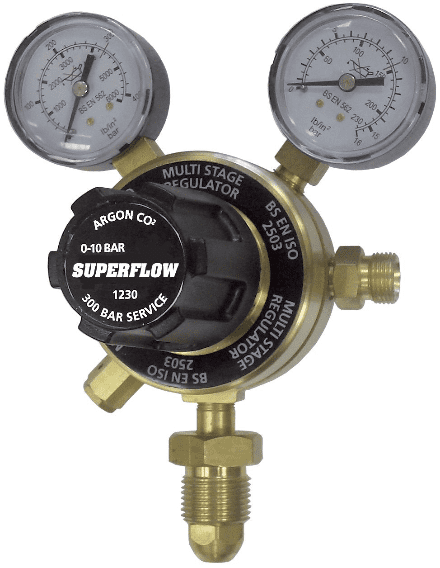
Multi-stage Argon regulator, designed for for use where constant pressure and flows are critical until the cylinder empties.BS EN ISO 2503. 3 Year warranty.
Why Use a Multi-Stage Argon Regulator ?
Improved Gas Pressure Stability
Unlike single-stage regulators, a multi-stage regulator reduces cylinder pressure in two or more controlled stages. This design provides:
- More consistent outlet pressure
- Reduced fluctuation as cylinder pressure drops
- Smoother gas delivery during welding
This stability is particularly important in TIG welding, where shielding gas consistency directly affects:
- Arc stability
- Weld pool protection
- Weld appearance and contamination control
Enhanced Shielding Gas Control
Argon shielding gas protects the molten weld pool from atmospheric contamination such as oxygen, nitrogen, and moisture. A multi-stage regulator helps maintain a precise and stable gas flow, reducing the risk of:
- Porosity
- Oxidation
- Tungsten contamination
- Inconsistent weld penetration
This is critical for high-quality welding of:
- Stainless steel
- Aluminium
- Titanium
- Exotic alloys
Ideal for Precision TIG Welding
Multi-stage regulators are commonly preferred for TIG welding because the process is highly sensitive to gas flow variations. Stable gas delivery helps achieve:
- Cleaner welds
- Improved arc starting
- Better weld colour on stainless steel
- Reduced post-weld cleaning
The regulator is especially beneficial when welding thin materials or carrying out precision fabrication work.
Benefits Over Single-Stage Regulators
A multi-stage design offers several operational advantages:
- Greater pressure accuracy
- Reduced “creep” in outlet pressure
- More stable gas flow over the cylinder lifespan
- Improved consistency during long weld runs
- Better performance in industrial and precision welding environments